
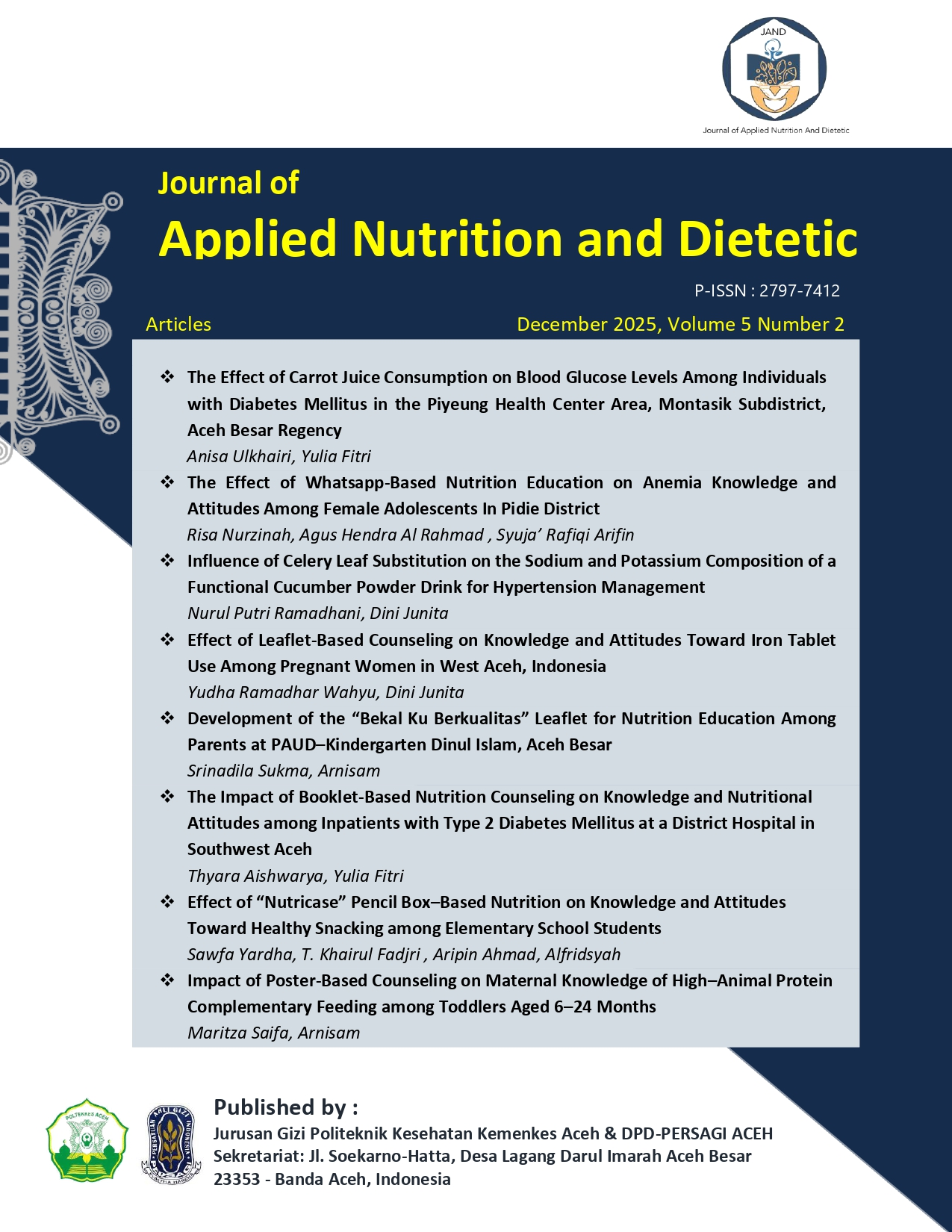
The Effect of Carrot Juice Consumption on Blood Glucose Levels Among Individuals with Diabetes Mellitus in the Piyeung Health Center Area, Montasik Subdistrict, Aceh Besar Regency
DOI:
https://doi.org/10.30867/jand.v5i2.925Kata Kunci:
Daucus carota L., Carrot juice, blood glucose, diabetes mellitus, glycemic controlAbstrak
Diabetes mellitus is a chronic metabolic disorder characterized by elevated blood glucose levels resulting from impaired insulin production or utilization. In addition to pharmacological therapy, blood glucose control can be supported through the use of herbal interventions such as carrot juice. Carrots (Daucus carota L.) are low calorie, high fiber vegetables rich in antioxidants, including vitamin C, β-carotene, lycopene, and flavonoids which may protect pancreatic β-cells and help reduce blood glucose levels. This study aimed to examine the effect of carrot juice consumption on blood glucose levels among individuals with diabetes mellitus. A quasi-experimental design with a pre-test–post-test control group was employed at the Piyeung Health Center, Montasik Subdistrict, Aceh Besar Regency. A total of 32 participants were selected using purposive sampling and divided into two groups: the treatment group, which received carrot juice daily for seven days, and the control group, which received mineral water for the same duration. Blood glucose levels were measured using an Easy Touch device. Data were analyzed using paired and independent t-tests in SPSS, and the results were presented in tabular and textual form. The mean blood glucose level before carrot juice administration was 221.88 mg/dL, which decreased to 199.88 mg/dL after the intervention, indicating a reduction of 22.0 mg/dL. The findings demonstrate that carrot juice consumption significantly reduces blood glucose levels among individuals with diabetes mellitus in the Piyeung Health Center area (p < 0.05).
Referensi
Bayhakki, Khairunnisa, H. (2017) ‘Effectiveness of Health Education on Cup Cake BBW (Broccoli, Spinach, Carrot) as LowCalorie Food on the Knowledge of Type 2 Diabetes Mellitus Patients’.
Dwi, S.N. (2020) ‘Antidiabetic Activity Test of Insulin Resistance of Carrot Extract (Daucus carota L.) in Swiss-Grade Male Mice’.
Ekasari, E., & Dhanny, D. R. (2022). Factors Affecting Glucose Levels Blood Glucose Levels of Type Ii Diabetes Mellitus Patients Aged 46-65 Years in the Regency of Wakatobi Regency. Journal of Nutrition College, 11(2), 154-162.
Hartati, & Fidrianny, A.F. (2023) ‘Fiber Review of Chemical Content and Pharmacological Activity (Daucus Carota L.)’, 48(2).
Lismeri, L., Ginting, E.B., Darni, Y., &A. (2023) ‘Extraction of Lycopene from Tomato Fruit (Solanum Lycopersicum) Using N-Hexan Solvent’, 8, pp. 96-103.
Milviniva, W., & Daan, D. (2023) ‘pontianak Nutrition Journal Effect of Red Guava Juice (Psidium guajava Linn) on Blood Glucose Levels’, 6(September), pp. 442-448.
Nissa, F., & Fitriani, M. (2018) ‘Relationship of Vitamin C, Vitamin E and B-carotene Intake with Fasting Blood Glucose Levels in Women 35-50 Years of Age’, 7, pp. 84-91.
Purwaningtyastuti, E. N. H. (2016) ‘The Relationship of Antioxidant Intake with Blood Glucose Levels in Type 2 DM Outpatients at Panembahan Senopati Bantul Hospital Yogyakarta’.
Rahayuningsih, C. K. (2016) ‘Effect of Olive Oil Addition during Boiling on Lycopene Content in Carrots’, pp. 116-123.
Ramadhani,A.A., & Khotami,R (2023). Relationship between Level of Education, Knowledge, Age and Family History of DM with Diabetes Prevention Behavior. Prevention of Type 2 Diabetes Mellitus in Young Adults. SEHATMAS: Scientific Journal of Public Health, 2(1), 137-147.
Sagita, P., Apriliana, E., & Sofyan, M. T.U.S. (2020) ‘Effect of soursop leaves on diabetes’, Jurnal Medika Hutama, 3(1), pp. 1266-1272.
Sari, A.E., & Maya, E.S. (2019) ‘Analysis of Beta Carotene Content and Antioxidant Activity in Indonesian Local Fruits’.
Setiawan, D. (2019) ‘Effectiveness of Dragon Fruit and Bengkuang Juice on Blood Glucose Reduction in Diabetes Mellitus Patients in Takeran Village, Takeran District, Magetan Regency’.
Soviana, E., & Rachmawati, N.S.W. (2014) ‘Effect of β-carotene supplementation on blood glucose levels and malondialdehyde levels in Streptozotocin-induced sprague dawley rats’, The Indonesian Journal of Nutrition, 2(2), pp. 41-46.
Suharti, N. H., Saputra & Dharma, S. (2011) ‘Effect of Carrot Juice (Daucus carota, Linn) on Blood Glucose Levels of Female White Mice’, Journal of Pharmaceutical Science and Technology, 16(2), pp. 138-143.
Sulastri, (2021) Smart Book of Diabetes Mellitus Care:Application of Indonesia nursing Diagnosis Standards (SDKI), Indonesia Nursing Outcome Standards (SLKI), Indonesian Nursing Intervention Standards (SIKI). Jakarta:CV. Trans Info Media
Tarigan, R. (2022). The Relationship Between Lifestyle And The Occurrence Of Diabetes Melitus Disease At Dr. R.M. Regional Hospital. DJOELHAM. Priority Nursing Journal, 5(1), 94-102
Wardani, U. E. (2023) ‘The Relationship Between Diabetes Mellitus and Glaucoma’, 04(02), pp. 3280-3292.
Unduhan
Diterbitkan
Cara Mengutip
Terbitan
Bagian
Lisensi
Hak Cipta (c) 2025 JAND: Journal of Applied Nutrition and Dietetic

Artikel ini berlisensiCreative Commons Attribution-ShareAlike 4.0 International License.









 Portal Garuda.
