
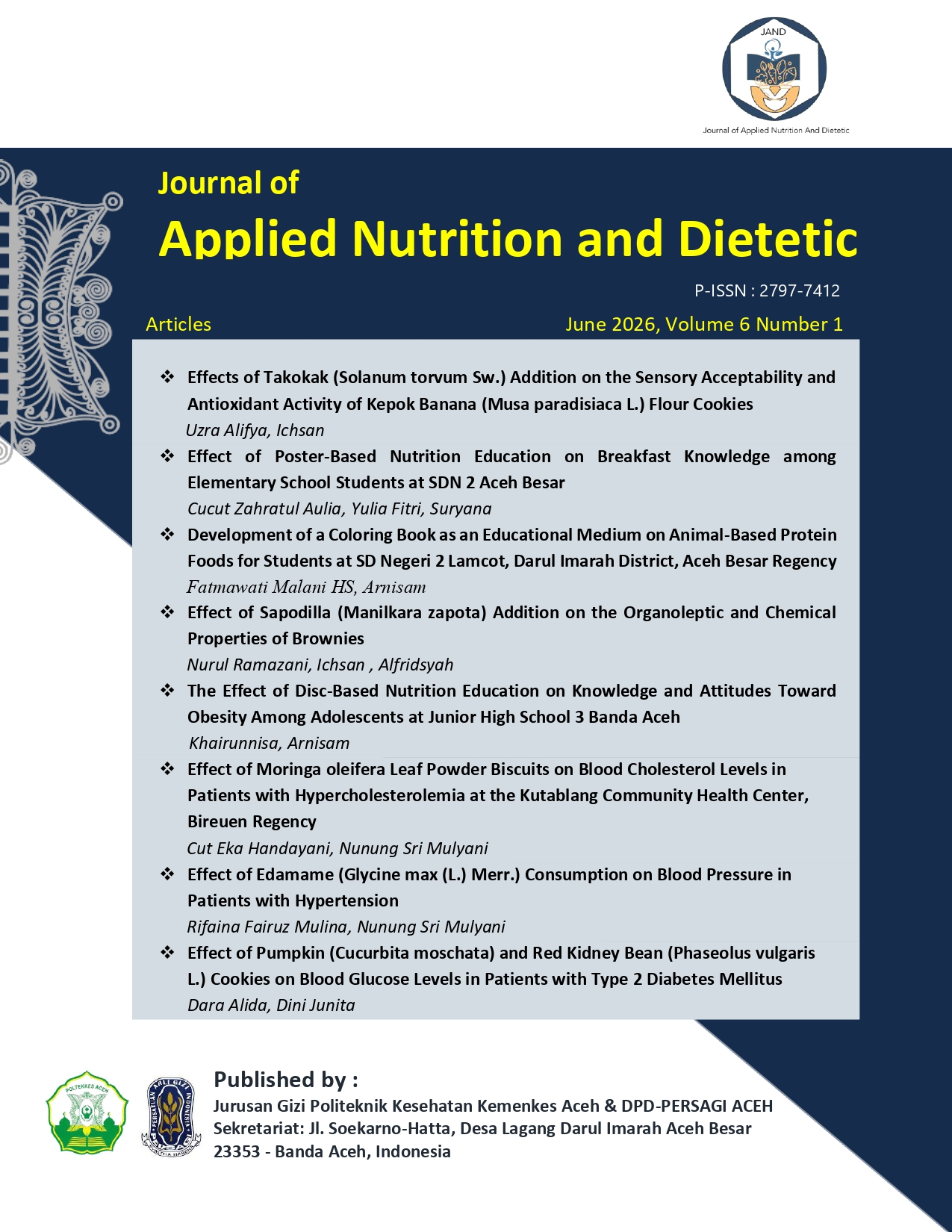
Effects of Takokak (Solanum torvum Sw.) Addition on the Sensory Acceptability and Antioxidant Activity of Kepok Banana (Musa paradisiaca L.) Flour Cookies
DOI:
https://doi.org/10.30867/jand.v6i1.929Kata Kunci:
antioxidant activity, cookies, functional food , kepok banana flour, Solanum torvumAbstrak
Takokak (Solanum torvum Sw.) and kepok banana (Musa paradisiaca L.) are rich in antioxidant compounds with potential health benefits, yet their utilization in functional food products remains limited. This study aimed to evaluate the effect of incorporating takokak fruit into cookies formulated with kepok banana flour on sensory acceptability and antioxidant activity. A non-factorial Completely Randomized Design (CRD) with three formulations and three replications was employed. Sensory evaluation was conducted using a hedonic test by semi-trained panelists to assess color, aroma, taste, and texture. Antioxidant activity was determined using the 2,2-diphenyl-1-picrylhydrazyl (DPPH) assay. Data were analyzed using analysis of variance (ANOVA), followed by Duncan’s Multiple Range Test. The formulation containing 140 g of kepok banana flour and 10 g of takokak fruit (FA) achieved the highest acceptability for taste, aroma, and texture, whereas the formulation containing 120 g of kepok banana flour and 30 g of takokak fruit (FC) was most preferred for color. The incorporation of takokak fruit had no significant effect on color or aroma but significantly influenced taste, texture, and antioxidant activity (p < 0.05). These findings indicate that takokak fruit can be successfully incorporated into kepok banana flour cookies to enhance their antioxidant properties while maintaining acceptable sensory quality. Further studies should investigate pre-treatment methods to reduce the characteristic bitterness of takokak fruit and optimize the nutritional and functional properties of the final product.
Referensi
Abdulkadir, A. R., Mat, N., Hasan, M. M., & Jahan, M. S. (2016). In vitro antioxidant activity of the ethanolic extract from fruit, stem, and leaf of Solanum torvum. ScienceAsia, 42(3), 184–189. https://doi.org/10.2306/scienceasia1513-1874.2016.42.184
Adeola, A. A., & Ohizua, E. R. (2018). Physical, chemical and sensory properties of biscuits prepared from flour blends of unripe cooking banana, pigeon pea and sweet potato. Food Science & Nutrition, 6(3), 532–540.
Ajila, C. M., Leelavathi, K., & Rao, U. J. S. P. (2008). Improvement of dietary fiber content and antioxidant properties in soft dough biscuits with the incorporation of mango peel powder. Journal of Cereal Science, 48(2), 319–326.
Darkwah, W. K., Koomson, D. A., Miwornunyuie, N., Nkoom, M., & Puplampu, J. B. (2020). Review: Phytochemistry and medicinal properties of Solanum torvum fruits. All Life, 13(1), 498–506. https://doi.org/10.1080/26895293.2020.1817799
Dewa, F., Sari Lubis, M., Indrayani Dalimunthe, G., & Yuniarti, R. (2024). Formulasi Tablet Hisap Serbuk Rimbang (Solanum torvum Sw.). Jurnal Farmasi, Sains, Dan Kesehatan, 3 (2), 171–182.
Faisal, H., Andry, M., Lumbantoruan, J. M., & Farmasi, P. S. (2024). Pemanfaatan Ekstrak Buah Takokak (Solanum torvum Sw.) Pada Formulasi Minuman Suplemen Sebagai Sumber Antioksidan 1,. 22 (02), 222–237.
Fu, V., Apridamayanti, P., & Luliana, S. (2023). Aktivitas Antioksidan Ekstrak Air Kombinasi Kulit Pisang Kepok (Musa paradisiaca L.) dan Nanas (Ananas comosus L.) dengan Metode DPPH dan FRAP. 3 (2), 235–246.
Holinesti, R., & Santri, R. (2022). Pengaruh Substitusi Tepung Pisang Kepok dan Ekstrak Buah Takokak Terhadap Kualitas Chocochip Cookies. Jurnal Pendidikan Tata Boga Dan Teknologi, 3 (3), 159.
Khoozani, A. A., Birch, J., & Bekhit, A. E. D. A. (2019). Production, application and health effects of banana pulp and peel flour in the food industry. Journal of Food Science and Technology, 56(2), 548–559.
Lobo, V., Patil, A., Phatak, A., & Chandra, N. (2010). Free radicals, antioxidants and functional foods: Impact on human health. Pharmacognosy Reviews, 4(8), 118–126.
Malau, M. S., Vonny, D. A. N., & Johan, S. (2022). Pemanfaatan Tepung Pisang Kepok Dan Tepung Tempe Dalam Pembuatan Cookies. 21 (2), 79–85.
Melisa, N., Hartianti, I., Prakoso, V. F., Teruna, H. Y., & Hendra, R. (2018). Aktivitas Antioksidan Dan Toksisitas Ekstrak Daun Coleus Scutellarioides. MPI (Media Pharmaceutica Indonesiana), 2 (1), 9–12.
Nuaeni, I., Proverawati, A., & Prasetyo, T. J. (2022). Karakteristik Sensori Cookies Bersubstitusi Tepung Pisang Kepok Dan Disuplementasi Tepung Cangkang Telur Ayam. Journal of Nutrition College, 11 (1), 74–86.
Pangondian Harahap, A., Rambe, R., Paramitha, R., & Yulanda, Y. (2022). Standarisasi Dan Perbandingan Uji Aktivitas Antioksidan Dari Ekstrak Etanol Dan Dekok Daun Senggani (Melastoma malabathricum L.) Dengan Menggunakan metode DPPH. Forte Journal, 2 (1), 11–21.
Singh, B., Singh, J. P., Kaur, A., & Singh, N. (2016). Bioactive compounds in banana and their associated health benefits: A review. Food Chemistry, 206, 1–11.
Tristantini, D., Ismawati, A., Pradana, B. T., & Jonathan, J. G. (2016). Pengujian aktivitas antioksidan menggunakan metode DPPH pada ekstrak daun tanjung (Mimusops elengi L.). Prosiding Seminar Nasional Teknik Kimia "Kejuangan", Yogyakarta.
Unduhan
Diterbitkan
Cara Mengutip
Terbitan
Bagian
Lisensi
Hak Cipta (c) 2026 JAND: Journal of Applied Nutrition and Dietetic

Artikel ini berlisensiCreative Commons Attribution-ShareAlike 4.0 International License.









 Portal Garuda.
